Showing posts with label Law. Show all posts

Friday, June 28, 2013

Moral Issues About Dating Coworkers

Interpersonal relationships play a critical role in daily workplace operation; without the ability to create rapport, employees may not establish strong communication. Given how much time people spend in the workplace, it's easy to understand the lure of dating coworkers; when those working relationships cross over into office romances, however, the moral component of such intimate interaction comes into play.

Policy
The desire to curb romances with a no-dating policy has increased with the growing awareness of sexual harassment in the workplace. This heightened awareness aside, companies are not jumping on the no-dating bandwagon as much as it might seem; just 12 percent of survey respondents in 2003 implemented such a policy, according to the American Management Association (AMA), with the majority specifically prohibiting morally questionable boss/employee fraternizing. Even with such a rule in place, there may be little legal power to enforce it if the state considers it privacy infringement. To sidestep this possibility, employers can impose an ethics code that more solidly supports the company's stance.

Hostile Work Environment
The ethical components of an office affair can impact other employees if it's known that one or both workers are cheating on their spouses with another staff member. The workplace can also turn hostile once the affair is over and the one-time lovers are not emotionally capable of working in the same space. Moreover, the burden of liability may fall upon the employer if one of the romantic pair files a harassment complaint that's not immediately addressed and rectified.

Turning a Blind Eye
While employers may not be happy with knowing their subordinates are fraternizing, they may respect the couple's privacy as long as the relationship does not detrimentally impact either employee's job performance. Should such concerns as favoritism from one toward the other, arguing in the office or decline in productivity arise, the boss has reason to step in.

Legal Aspects
What employees do on their own time is beyond the scope of workplace policy; however, once the relationship spills over into office space, the amorous coworkers cross a line that takes them into more legally stringent territory. For example, if they exchange personal and/or intimate messages while using a department computer on company time, the employer is within rights to take action as long as an electronic messaging policy is in place.

Originally written for and published by Demand Media
Photo credit: Brand X Pictures/Brand X Pictures/Getty Images

Tuesday, May 28, 2013

Just Cause for Turning Down a Job Interview While on Unemployment

Obtaining unemployment benefits may be a standard next step to bridging the financial gap when you're jobless through no fault of your own, but those subsidized paychecks are not automatically tendered without some serious effort on your part. Unemployment compensation is granted to those job seekers who, once deemed "able and available" for suitable work, do not turn down an interview for any job without "good cause."

Proving "Able and Available"
Being able and available means you possess marketable skills. While it's not your responsibility to identify available jobs, you do have to demonstrate there is a market for your specific experience. For example, creating matchstick animals may be an entertaining talent, but there is no demand for it within the labor sector. Able and available also speaks to your physical capacity to actually carry out the work, as well as having a dependable means of transportation to get to and from the job.

Imposing Job Restrictions
Job seekers are allowed to establish certain boundaries when it comes to the type of jobs they'll accept and still be considered able and available. Health issues, for instance, can dictate whether a position is suitable where there is heavy lifting or unhealthful environmental factors, such as allergens. You may also cite lack of transportation as the reason for only seeking jobs within walking distance, but the onus is on you to demonstrate reasonable attempts to rectify the situation prior to requesting a restriction.

Suitable Work
Suitable work is determined by courts and unemployment compensation referees after considering various factors of your specific situation. These can include work experience and training; proximity of home to job; why and how long job seeker is out of work; plausibility of securing a job close to home in skilled profession; previous wages; job market climate; normal occupational pay rate; and residence permanency.

With and Without "Good Cause"
Refusing a job for "good cause" may include a mismatch of skills to position; physical inability to complete required tasks of that particular job; conflict between religious beliefs and job requirements; lack of transportation; and inability to secure quality childcare during work hours. You must make reasonable effort to rectify the latter two before refusing a job. Suitable jobs refused without good cause can cost job seekers their unemployment compensation when, for example, full-time employment is offered yet only part-time is wanted or vice versa, and refusing to accept a lower pay rate than previously earned.

Photo Credit: Goodshoot/Goodshoot/Getty Images
Originally written for and published by Demand Media

Friday, August 24, 2012

Top 10 Dog Breeds With Bad Reps


Breed specific legislation in states and munici-palities across the country has targeted many types of dogs that, often through no fault of their own, are labeled as dangerous. Breeds classified under this law can cause an increase in insurance rates for homeowners or may face euthanasia.

Blackballed Breeds
Dogs of every breed respond to the stimuli presented to them, whether nurtured by love and trust or provoked by pain and fear. Certain breeds, however, are considered more dangerous than others, including the Akita, bulldog, bullmastiff, chow, Doberman, German shepherd, husky, Presa Canario, Rottweiler and pit bull, or any mix-breed combination thereof.

Size Matters?
Each of the dogs on this Top 10 list is considered large, extra-large or giant based upon breed size standards, which indicates that the bigger the dog, the more dangerous he is -- or is perceived to be. While dog breed statistics do reflect a higher number of incidents in association with the 10 breeds on this list, Dog Bite Law says that dogs of certain breeds are not born dangerous by default. "Any individual dog may be a good, loving pet, even though its breed is considered to be potentially dangerous."

Identifying a Pit Bull
The pit bull is branded as more dangerous than any other not only through misled perception but also because many people cannot identify the breed. Dogs with triangular jaws, muscular bodies and cropped ears are all lumped together as the generic "pit bull," when in fact the pit bull can be any of the following breeds: American Staffordshire terrier, English bull terrier, American bulldog, Presa Canario and Staffordshire bull terrier. The subtle differences of each one have cast them all into a much-debated single grouping based only upon how they look.

The Human Element
The common denominators among these 10 dog breeds are strength, size, independent attitude and intelligence, making them highly sought-after as guard and protection dogs, as well as combatants in the fighting ring. According to Dog Bite Law, any breed of dog is capable of biting when trained to do so; dogs whose physiques make them more popular sentries than their smaller, allegedly "non-dangerous" counterparts are often taught to attack, which brings more attention to incidents involving these particular breeds.

Originally written for and published by Demand Media

Monday, August 20, 2012

Careers Without a College Degree

While a college degree has historically been the bridge to professional success, there are industries where basic training and hands-on experience are just as valuable as -- and sometimes more than -- higher education.

Hospitality
Many a teenager begins his career path at a fast-food outlet or local restaurant, actively participating in back-of-the-house operations -- dishwasher and food preparation -- or front-house customer service. This seemingly inconsequential experience can open many doors for future advancement throughout a worldwide industry that includes working as a Four Star hotel manager, restaurant owner or concierge.

Detectives and Criminal Investigators
If you have a keen eye for detail and a flair for sleuthing, the lack of a college degree won't stand in your way of a career in criminal law enforcement. Prerequisites for detectives and criminal investigators are more mental and physical than scholastic, calling for rigorous qualifications of sound mind and body. The most common path is entering the force as a police officer after successful completion of the academy program and then moving up the ranks with increased experience.

Real Estate Agent
Helping people buy and sell property can be a very rewarding and lucrative career choice. Indeed, there are few things as intimate as the place you call home, which brings a sense of personal satisfaction when clients are gratified. While real estate agents don't need a degree, they do need to be licensed and stay up-to-date on changing requirements, laws and forms through continuing education.

Computer Technology
The future is strong for those who immerse themselves in technology. With many elementary and secondary schools incorporating computer education in their curricula, young people have opportunities to develop skills that set them on the path toward a solid career without having a degree. Successful computer programmers, for example, are often self-taught. Courses in continuing education do offer advanced certification to further knowledge but in most cases, all you need is raw talent, experience and competence to land a position.


Originally written for and published by Demand Media

Wednesday, June 6, 2012

Laws & Employment Ads


Employers might have a certain idea of the person best suited for a given position, but listing these specific character-istics in an employment advertisement -- beyond the scope of a job's general description -- can land the company in legal hot water. Discrimination of any sort, either real or perceived, is at the forefront of staff recruitment to such an extent that employers must be keenly aware of how to lawfully word a job ad.


Legislative Mandate
Even with the prevalence of anti-discrimination employment laws, some employers still don't know that job advertisements fall into this legal category. According to the U.S. Equal Employment Opportunity Commission, the classifications protected from biased want ads include race, religion, national origin, color, sex, age, genetic information or disability. Pregnant women, who cannot be singled out or treated differently in the workplace, are listed as a subgroup of the gender category.


Sidestepping the Unemployed
Some employers place a time limit on how long applicants can be out of work in a given industry before they're considered unemployable; the longer a person is gone from the job market, the more likely he is to be out of touch with industry evolution. Employment attorney Ann Kieran says New Jersey's 2001 statute N.J.S.A. 34:8B-1 was one of the nation's first prohibiting companies from stating in any way, either online or in print, that those currently unemployed will not be considered. A dozen more states considered the same legal mandate in early 2012 and in February, the Oregon Legislature voted in favor of levying employers with a $1,000 fine for publishing such discriminatory job ads.


Gender-Referent Language
Advertising for a waitress rather than a food server sends a clear message the employer wants to hire a woman, which is a form of gender-referent language. A male job seeker who might otherwise apply for that job is immediately discouraged from doing so, yet cannot be legally turned away if he does. While there are limited circumstances whereby gender is a bona fide occupational qualification, such as in a prison or gender-specific health facility, the majority of employers are strongly advised to use gender-neutral job titles and descriptions in their advertisements.


Ageism
Discouraging the over-40 job seeker from applying for a non-age specific position is another form of employment discrimination. For example, the employer who advertises "recent college graduates" for a sales job that any seasoned professional twice that age can handle violates the Age Discrimination in Employment Act. Companies that use these trigger words, which also include citing specific age ranges, tread on thin ice where their liability is concerned if the position does not actually require that particular qualification.


Originally written for and published by Demand Media

Tuesday, February 28, 2012

Increase Your Chances of Becoming a Custodial Parent

Many chall-enges are associated with getting divorced; establishing custodial rights may be the most painful. Children can too easily become pawns when a couple wants to exact re-venge upon each other. For this reason, the court pays close attention to how the mother and father fulfill their respective parental responsibilities, as well as their personal lifestyle choices. In the end, it all comes down to what's in the best interest of the child, so do everything possible to present yourself as the better parent.

Realize that judges don't automatically give mothers custodial rights. Each parent must prove why he or she offers a better living arrangement.

Educate yourself on what criteria the court uses to determine which parent is more fit. These criteria include finances, physical and mental health, professional stability, the child's age and where he or she is currently schooled, along with the relationship each parent has with the child. According to the Separated Parenting Access & Resource Center, the older the child is, the more input he or she has in determining which parent receives custody.

Hire a lawyer with extensive family law experience to help avoid the potential for judicial prejudice. While judges are supposed to be impartial, the American Bar Association points out that some will silently impart their personal biases. Expect your attorney to be skilled enough to know which evidence works in your favor and which detracts from it.

Refrain from dating while involved in a custody battle. The court is not supposed to consider this behavior when making a decision, but judges often look upon it as a distraction from the child's best interest. A parent already living with a new partner will carry the burden of proving this new relationship doesn't negatively affect the child.

Accept that your religious beliefs and practices may play a role in whether you're granted custodial rights. Legally, the court's only concern with a parent's chosen religion should be how it may affect the child's care. However, children raised in a particular faith may be placed with the parent who more closely continues the religious tradition.


Originally written for and posted on eHow

Thursday, December 29, 2011

Sandbagging the Innocent: False Conviction and Eyewitness Testimony

Can you remember what you had for lunch yesterday? Does it take a bit of effort to recall your mother-in-law's birthday? Are you comfortable trusting your life to an eyewitness who struggles to remember crucial details while testifying against you?

Kids play an entertaining game called Telephone where one child whispers a short phrase to the next child, who then whispers it to the third one. Once the last child in line finally hears the sentence and recites it back to the group, it has been retold with so many errors that it's completely distorted. This phenomenon of human nature, which illustrates how differently people perceive the same situation, also holds true when relying upon eyewitness testimony and false memories as irrefutable courtroom evidence.

Blind Trust
The inherent fallibility of eyewitness testimony has been the focus of myriad debates, with research illustrating how first-hand observers are easily distracted by certain lines of questioning: their recollection becomes skewed and the answers they provide meld into what they perceive to be the truth. Elizabeth Loftus has spent much of her life tracking this particular phenomenon, noting how details surface more readily with repeated and exhaustive questioning; as such, eyewitness answers no longer pertain to the events that occurred, but rather to the leading questions being asked.

Employing recovered memories as an eyewitness proves even more dangerous for getting at the truth, given the trend toward psychotherapy that compels individuals to "remember" things that either did not happen or whose facts have been so altered that only a smattering of truth remains. The techniques by which this often erroneous information is extracted have come under considerable scrutiny, standing accused of instigating the repressed – if not faulty – memories that too easily put innocent people behind bars.

"Therapists' accounts, patients' accounts, and sworn statements from litigation," says Loftus, "have revealed that highly suggestive techniques go on in some therapists' offices." Loftus, who has spent an entire career pointing out the dangers of blind trust particularly when dealing with the fate of an individual on trial, claims "the most horrifying idea is that what we believe with all our hearts is not necessarily the truth."

The Lie That Ruined A Life
The
Gerald Amirault case presents a particularly disturbing example of the feeding frenzy that develops from false accusation. Based solely upon the coerced testimony of young children who claimed the Fells Acres Day School attendant sexually abused them, a wholly innocent man was sentenced to more than 30 years in prison; his mother and sister, both of whom were teachers at the day care, were given 8-20 years under the same umbrella of erroneous accusation and false witness

The real story of what occurred bears no resemblance to the one that spread like wildfire: Gerald -- 
whose job was to perform odd jobs around the facility such as repairing, cooking and driving –- changed clothes on a 4-year-old boy who had wet them during nap time. A completely acceptable action was turned into an flagrant lie by a child with a history of behavioral issues including dishonesty and hostility. The story that forever ruined Gerald's life had him taking the boy into a secret room where he molested and raped the child.

Gerald
was granted a release in 2004, 18 years after being convicted of a crime he did not commit, but his nightmare was far from over. Branded a level three sex offender, saddled 24/7 with an electronic tracking device and forced to abide by strict curfew, he's hardly a free man. As Damian Penny duly points out, "a justice system is only as good as the flawed human beings who run it, and the system has failed Gerard Amirault miserably. Witch hunts tend to backfire in the long run, as people start to assume the witches never existed in the first place."

Children's photo from Wonder Time
Testimony photo from Kirk Garner
Puritan Witch Trial Notebook from BBC News

Wednesday, December 21, 2011

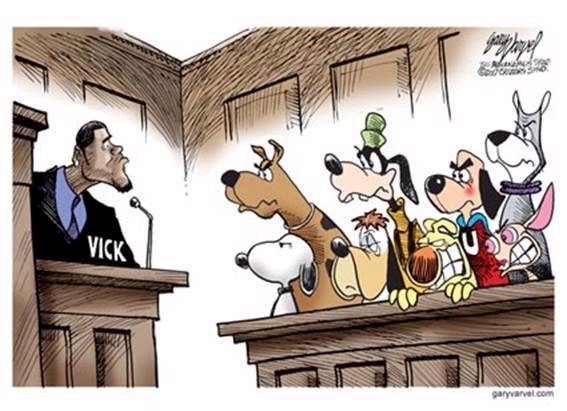
Stacking the Jury

Being judged by a jury of peers is an elusive reality in today's criminal justice system, inasmuch as the selection process has become more rooted in psychological manipulation than propriety. Forensic psychologists, who play an important role in how and why certain people are chosen for duty and others are not, use an inventory of questions that often have nothing at all to do with the case being tried.

Potential jurors endure a formal examination called voir dire that determines the appropriateness of each individual to occupy a jury seat; bias of any kind earns immediate dismissal. These prejudices are often easy to detect while others require deeper inquiry to uncover, an approach that typically re-asks a particular question in several different ways to see if the person trips over the answer. 

In theory, the entire selection process occurs for the single objective of assembling a fair and impartial jury; in reality, it has become a chronic hemorrhage of the legal system that prevents getting a fair community cross-section. Forensic psychologists ask questions that draw out certain responses, which can unfairly orchestrate a jury whose collective presence disrupts any chance of impartiality against the projected ruling.

Indeed, attorneys face quite a tremendous task when it comes to safeguarding a trial outcome against rogue jurors. Not only must they educate the jury about minutiae of the case, but they must also make it perfectly clear in layman's terms. Far too many uncontrolled variables can lead to slip-ups where individual jurors are concerned, so lawyers engage in a strategy called mock or shadow jury that represent the actions, opinions and biases of a real jury before ever reaching trial. Attorneys value these training sessions in order to present their case in a more thorough manner. It also helps them to learn how different people respond in different areas of the country. However, Decaire's assessment doesn't do much to appease suspicion:

The Forensic Psychologist that investigates the social-legal components of the common law court system can provide influential knowledge to both criminal and common law cases…Many believe that a good evaluator can determine, before the case, which jurors are on their side…Since both sides can challenge potential jurors this will not usually stack the jury in the favor of either the defense or prosecution. The result is hopefully a fairly balanced jury. 
All this judicial jockeying and scientific jury selection gives a dubious perspective to the implication of injustice. No matter how exacting the forensic psychologist is when profiling a potential jury, there is simply no surefire way to determine how verdicts in a mock trial (where controlled variables are used) will foretell that of a real trial. Jurors are, after all, ordinary people who may or may not have a vested interest in the case outcome. Is it reasonable to think a mock jury can anticipate how impartial and unprejudiced the real jury will be when it comes to matters of the heart?

Moreover, there's no telling whether any member of a mock or real jury will adhere to the judge's directions when a particularly damning piece of evidence is stricken from the record. There is also no guarantee a juror will not crumble under the pressure of other jurors to make the verdict follow majority. Too many individual quirks exist among people to expect them all to respond in the same manner. Juries may rely upon common sense when it comes to sorting out the facts, but they also fall prey to their often-overwhelming sense of compassion. This reason, more than any other, is likely why so many criminals are treated with leniency despite best efforts from forensic psychologists.